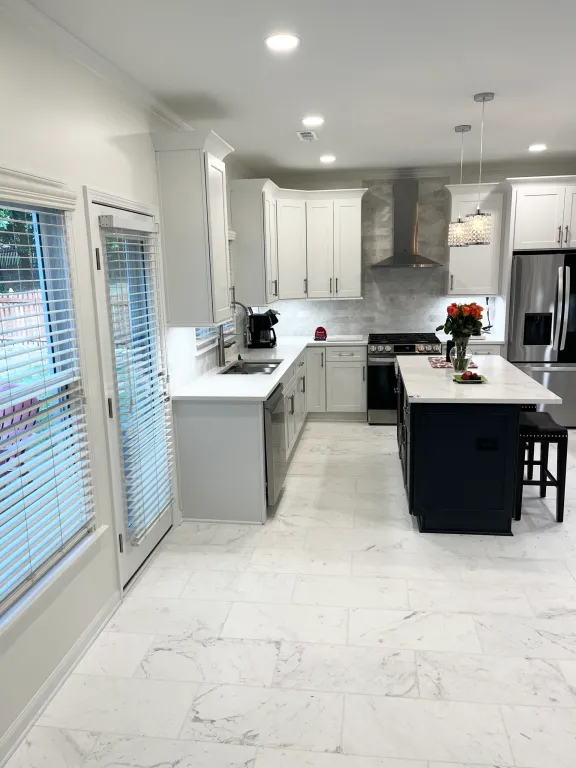

When homeowners start shopping for kitchen cabinets, they quickly encounter three terms: stock, semi-custom and custom cabinets.
The difference is not simply “cheap, medium and expensive.”
Each cabinet type is designed for a different combination of budget, layout, timeline and personalization.
A well-designed kitchen can use stock cabinets successfully, while another kitchen may genuinely need custom cabinetry to make the layout work.
Understanding the differences before visiting a showroom can save you from paying for features you do not need—or choosing cabinets that limit your renovation later.
Stock vs. Semi-Custom vs. Custom Cabinets at a Glance
| Feature | Stock | Semi-Custom | Custom |
|---|---|---|---|
| Price | $ | $$ | $$$ |
| Sizing | Standard | Standard + modifications | Built to specification |
| Design Choices | Limited | Extensive | Nearly unlimited |
| Lead Time | Fastest | Moderate | Longest |
| Layout Flexibility | Limited | Good | Excellent |
| Best For | Budget/simple layouts | Most homeowners | Complex/premium remodels |
The right choice depends on the kitchen—not simply the cabinet label.
What Are Stock Kitchen Cabinets?
Stock cabinets are manufactured in predetermined dimensions.
Instead of building cabinets specifically for your room, your kitchen design is created using available cabinet sizes.
They are usually offered in standard width increments with a limited selection of:
- Door styles
- Colors
- Finishes
- Interior options
- Accessories
Because manufacturers produce the same cabinet sizes in volume, stock cabinetry is typically the fastest and least expensive option.
Advantages of Stock Cabinets
Stock cabinets can make sense when:
- Your kitchen has a straightforward layout.
- You have a limited remodeling budget.
- You want a faster installation timeline.
- Standard sizes fit the room well.
- Extensive customization is unnecessary.
Today’s stock cabinets vary significantly in quality, so “stock” does not automatically mean poor construction.
Look at the actual materials, hardware and joinery rather than judging cabinets only by category.
Disadvantages of Stock Cabinets
The biggest limitation is flexibility.
If your kitchen has unusual dimensions, you may need filler strips or compromises in cabinet placement.
You also have fewer choices for finishes, door styles and specialty storage.
What Are Semi-Custom Kitchen Cabinets?
Semi-custom cabinets begin with a manufacturer’s standard cabinet system but allow more modifications.
Depending on the product line, homeowners may be able to customize:
- Cabinet heights
- Cabinet depths
- Door styles
- Paint colors
- Wood finishes
- Drawer configurations
- Interior accessories
- Decorative panels
Semi-custom cabinetry is popular because it provides significantly more design freedom without requiring every cabinet to be built from scratch.
Are Semi-Custom Cabinets Worth It?
For many homeowners completing a full kitchen remodel, they can be.
Semi-custom cabinets often provide the right balance of:
- Quality
- Price
- Storage
- Appearance
- Flexibility
They are particularly useful when you want your kitchen to feel personalized but do not have unusual architectural conditions requiring fully custom cabinetry.
Semi-custom is often the practical middle ground between an off-the-shelf layout and a completely bespoke kitchen.
What Are Custom Kitchen Cabinets?
Custom cabinets are built for a specific kitchen rather than selected from predetermined sizes.
The cabinetmaker can create cabinetry based on your exact dimensions and design requirements.
This provides far more control over:
- Width
- Height
- Depth
- Materials
- Door profile
- Finish
- Interior configuration
- Storage accessories
Custom cabinets are especially useful in kitchens with unusual architecture.
When Are Custom Cabinets Worth It?
Custom cabinets may be worth considering when:
Your Kitchen Has Unusual Dimensions
Older houses are not always perfectly square.
Custom cabinets can be built around uneven walls, unusual corners or non-standard ceiling heights.
You Want Floor-to-Ceiling Cabinetry
Custom dimensions can create a more built-in appearance and reduce awkward gaps.
Storage Is a Major Priority
A custom design can make use of areas that standard cabinetry may leave unused.
You Want a Specific Design
If you have a particular finish, wood species or architectural style in mind, fully custom cabinetry gives you the most flexibility.
You Are Completing a High-End Renovation
For premium kitchens where every design detail matters, custom cabinetry can create a cohesive built-in appearance.
Does Custom Mean Better Quality?
Not automatically.
Cabinet category and cabinet quality are related, but they are not the same thing.
A well-manufactured stock or semi-custom cabinet may outperform a poorly built custom cabinet.
When comparing cabinets, look beyond the label.
Ask about:
- Cabinet box material
- Drawer construction
- Shelf thickness
- Hinges
- Drawer slides
- Finish quality
- Warranty
- Installation
A beautiful cabinet door does not tell you how well the cabinet itself is built.
Plywood vs. Particleboard Cabinets
This comparison comes up often during kitchen remodeling.
Plywood is frequently chosen for higher-quality cabinet boxes because it provides strength and good screw-holding capability.
Particleboard and engineered wood products can also perform adequately when manufactured and protected properly, particularly in budget-focused products.
The important point is understanding exactly what you are purchasing.
Ask whether the cabinet sides, back, shelves and drawers use the same material.
Framed vs. Frameless Cabinets
Cabinet construction also affects appearance and storage.
Framed Cabinets
Framed cabinetry has a face frame attached to the front of the cabinet box.
It is common in traditional American kitchen designs.
Frameless Cabinets
Frameless cabinetry eliminates the front face frame and attaches doors directly to the cabinet box.
This construction is often associated with contemporary and European-style kitchens and can provide slightly more interior access.
Neither design is automatically better.
Choose based on appearance, construction quality and how you want the kitchen to function.
Which Cabinet Type Is Best for a Budget Kitchen Remodel?
If controlling cost is the highest priority and your kitchen works well with standard sizes, stock cabinetry may be the best option.
Invest in the areas that affect everyday performance:
- Quality hinges
- Drawer slides
- Proper installation
- Durable finish
- Functional layout
There is little value in paying for extensive customization that your kitchen does not actually need.
Which Cabinet Type Is Best for Most Homeowners?
For many full kitchen renovations, semi-custom cabinetry deserves serious consideration.
It provides enough flexibility to create a personalized kitchen while keeping cost and lead time below many fully custom options.
A kitchen designer can often use semi-custom cabinetry creatively enough that the finished room appears completely tailored to the home.
Which Cabinet Type Is Best for a Luxury Kitchen?
Custom cabinets provide the most freedom for a high-end kitchen.
They work particularly well when you want:
- Furniture-style islands
- Integrated appliance panels
- Full-height cabinetry
- Specialty pantry systems
- Unique finishes
- Precise architectural details
However, custom cabinets should be part of an overall kitchen plan.
Expensive cabinetry will not fix a poor layout.
What Should You Spend Money on First?
Before upgrading decorative details, focus on functionality.
Prioritize:
- A practical kitchen layout
- Durable cabinet boxes
- Quality drawers and hardware
- Adequate storage
- Professional installation
After those essentials are covered, consider decorative upgrades such as specialty finishes, glass doors and elaborate trim.
How Does Cabinet Choice Affect Remodeling Timeline?
Cabinet lead time matters because other parts of the project depend on it.
Stock cabinets generally arrive fastest.
Semi-custom cabinetry requires additional manufacturing time.
Fully custom cabinets normally take the longest because they are built specifically for the project.
Cabinets should be selected early enough that their production schedule does not create unnecessary delays after demolition begins.
Frequently Asked Questions
What is the difference between stock and custom cabinets?
Stock cabinets come in predetermined sizes and styles, while custom cabinets are built to specific dimensions and design requirements.
Are semi-custom cabinets good quality?
They can be. Quality depends on the manufacturer, materials, construction and hardware rather than simply the semi-custom label.
Are custom cabinets worth the extra money?
They can be worthwhile for unusual layouts, high-end renovations or homeowners who require specific dimensions and finishes.
Which type of kitchen cabinet is cheapest?
Stock cabinetry is generally the lowest-cost option.
Which cabinets are best for a kitchen remodel?
There is no single best cabinet type. The right choice depends on your kitchen dimensions, budget, desired appearance, storage needs and remodeling timeline.
Should I choose cabinets before countertops?
Usually, yes. Cabinet dimensions and layout influence countertop measurements, appliance placement and many other design decisions.
Choosing Cabinets for a Gwinnett County Kitchen Remodel
Cabinets are too important to choose based only on color.
They affect storage, workflow, countertop layout, appliance placement and the overall budget.
Hill Residential Contractors provides kitchen remodeling services throughout Gwinnett County and North Atlanta, including kitchen planning, semi-custom and custom cabinetry, countertops, structural changes, electrical, plumbing and complete installation.
The best cabinet is not necessarily the most expensive one.
It is the cabinet system that fits your room, budget and everyday life without forcing unnecessary compromises.