
Open Concept Kitchen Remodeling Guide
- Not every wall between a kitchen and living area is safe to remove — always confirm load-bearing status first
- Removing a load-bearing wall with a structural beam typically adds $8,000–$18,000 to a project
- Open concept works best when kitchen, dining, and living areas share cohesive design language
- Ventilation design becomes more important in open kitchens — a quality range hood is non-negotiable
- Partial openings — pass-throughs, peninsulas — can achieve the feel without the full structural cost
Open concept kitchen remodeling is still one of the most-requested projects we take on in North Atlanta. Families in Alpharetta, Johns Creek, and Sandy Springs want the kitchen to connect to family life, not run parallel to it. But before anyone picks up a sledgehammer, there’s a process that separates a successful open concept renovation from an expensive disaster. This guide covers everything you need to know.
Before You Remove Any Wall: What Has to Happen First
Load-Bearing Wall Assessment
The most important step in any open concept kitchen remodeling project is determining whether the wall you want to remove is load-bearing. Load-bearing walls transfer the weight of the structure above them to the foundation. Removing one without proper support is a structural failure waiting to happen.
- Walls that run perpendicular to floor joists are more likely to be load-bearing
- Walls positioned above a basement beam or below a roof ridge are usually load-bearing
- The only reliable way to confirm is with a structural engineer or an experienced contractor who can assess from the attic, basement, and crawl space
- We pull permits for all structural wall removal — Gwinnett County requires engineering documentation
What’s Inside the Wall
- Electrical circuits — need to be rerouted before demo
- Plumbing supply or drain lines — relocation adds cost and timeline
- HVAC ductwork — more common than homeowners expect
- Gas lines — present occasionally in older homes with original layouts
Structural Beam Options When Removing a Load-Bearing Wall
LVL Beam vs. Steel I-Beam
Laminated veneer lumber (LVL) beams are the most common replacement for load-bearing walls in residential construction. They’re strong, dimensionally consistent, and typically concealed in the ceiling. Steel I-beams are used when spans are longer or loads are heavier — they’re more expensive but allow wider openings.
- LVL beam for spans up to 16–18 feet: typical cost $2,500–$5,000 for materials and installation
- Steel beam for longer spans or heavier loads: $5,000–$12,000
- Temporary shoring during removal and beam installation is required — don’t skip it
Design Considerations for Open Concept Kitchens
Creating Zones Without Walls
The design challenge in open concept remodeling is that you’ve removed the natural definition of spaces. Good open concept kitchens create zones through other means — flooring transitions, ceiling treatments, lighting, and furniture placement.
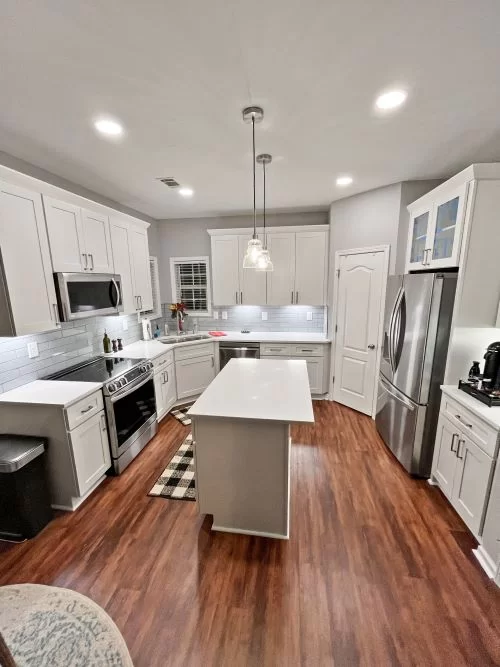
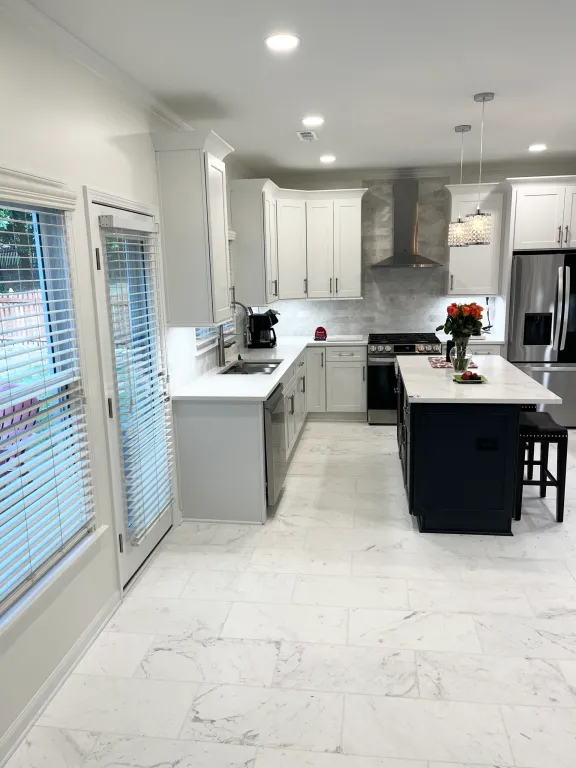
- A kitchen island defines the cooking zone and provides a visual separation from the living area
- Pendant lighting over the island anchors the kitchen zone
- A change in ceiling height or a coffered ceiling treatment marks the dining zone
- Consistent flooring throughout versus a tile-to-hardwood transition — both can work, each reads differently
Ventilation in Open Kitchens
An enclosed kitchen contains cooking smells. An open kitchen lets them travel to every connected space. This makes range hood specification more important than in a standard enclosed kitchen.
- CFM (cubic feet per minute) rating should be appropriate to your cooking style and burner BTU output
- Ducted hoods are far more effective than recirculating models for open layouts
- Island hoods require ceiling duct routing — plan this during the structural phase, not after
Partial Open Concept: When a Full Opening Isn’t Right
- A pass-through opening — a window-sized or half-wall opening — connects spaces without removing full structural load
- A peninsula anchored to one wall creates openness on three sides while maintaining some visual separation
- Pocket doors or barn doors allow the kitchen to be closed off when needed (useful for cooking smells, noise, and visual clutter)
- These solutions cost significantly less than full wall removal and can achieve a similar daily-life effect
Cost Breakdown for Open Concept Kitchen Remodeling
- Non-load-bearing wall removal and patch: $1,500–$3,500
- Load-bearing wall removal with LVL beam: $8,000–$15,000
- Load-bearing wall removal with steel beam, long span: $12,000–$22,000
- MEP rerouting (electrical, plumbing, HVAC) as needed: $2,000–$8,000
- Full kitchen renovation following the opening: see our article on kitchen remodel costs in Georgia
FAQ: Open Concept Kitchen Remodeling
How do I know if my wall is load-bearing?
You can make an educated assessment based on wall direction, location, and what’s above and below it, but the only definitive answer comes from a structural assessment. We evaluate this as part of every consultation for open concept projects.
Will opening up my kitchen reduce my home value?
In most North Atlanta markets, open concept layouts are a positive for resale value. Buyers in Alpharetta, Johns Creek, and Sandy Springs consistently respond well to open kitchen-to-family room connections. The caveat is quality of execution — a poorly done opening with visible patch work or an undersized beam looks worse than the original wall.
How long does an open concept kitchen project take?
The structural phase — wall removal, beam installation, patching — takes 1–2 weeks depending on complexity. If you’re doing a full kitchen renovation simultaneously, the total project typically runs 8–14 weeks. See our renovation process guide for more on timeline management.
Do I need a permit to remove a wall in Georgia?
Yes — any structural alteration requires a permit in Gwinnett County and surrounding jurisdictions. We pull all permits and work with inspectors throughout the project.
Can I open up my kitchen myself?
Cosmetic work — removing drywall from a confirmed non-load-bearing partition — can be DIY. But anything involving load-bearing structure, electrical, plumbing, or HVAC should be done by licensed contractors. The consequences of structural errors are serious and expensive to correct.
If you’re thinking about opening up your kitchen, the first step is an honest assessment of what you’re working with. Schedule a consultation with Hill Residential Contractors and we’ll tell you exactly what your project involves.