
Best Bathroom Remodeling Ideas for Small Bathrooms
- Large-format tiles make small bathrooms look bigger — 12×24 or larger laid vertically
- Wall-hung vanities free up floor space and make cleaning easier
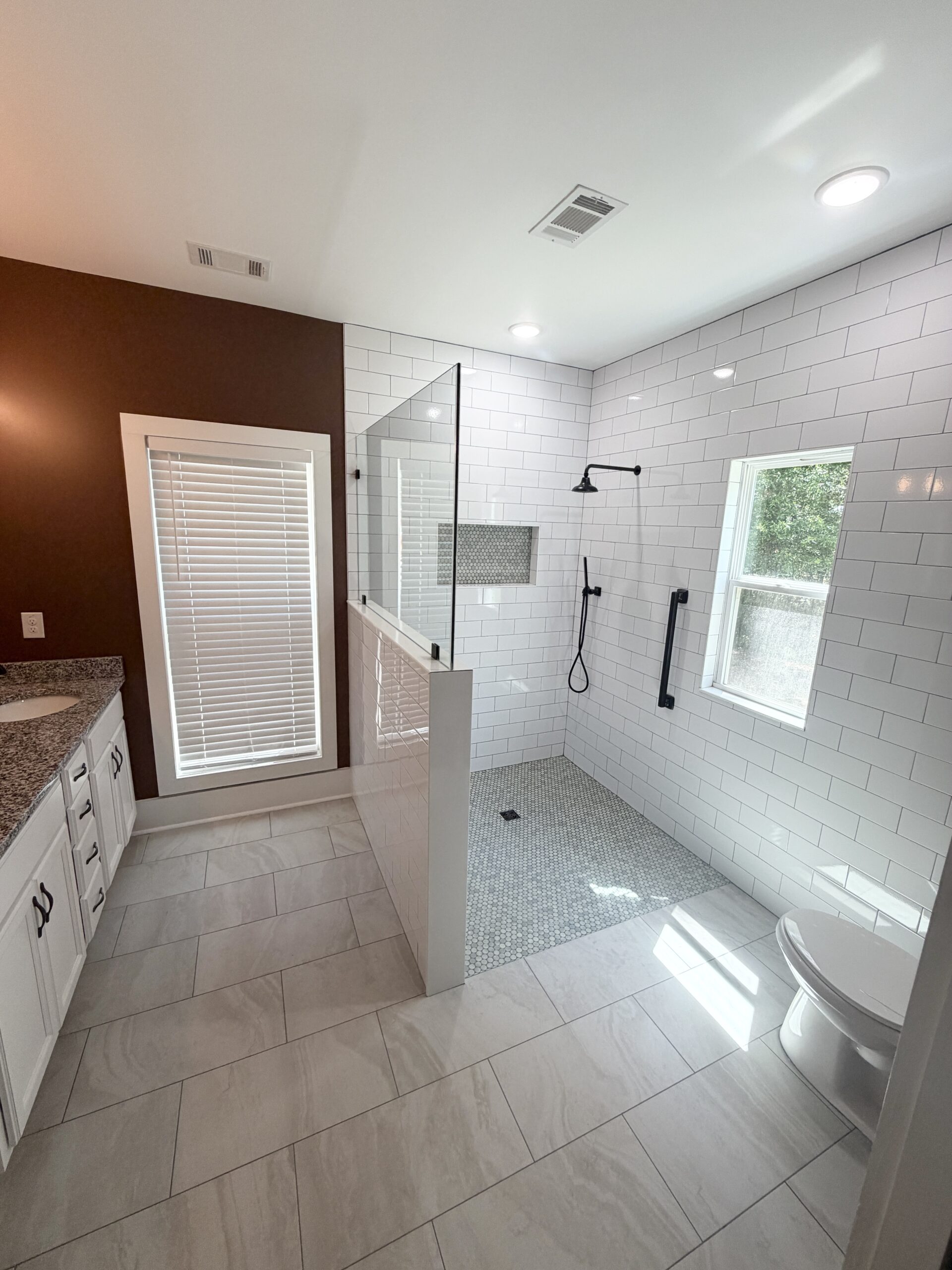
- A curbless shower eliminates the visual barrier that makes small baths feel cramped
- Proper lighting — especially at the mirror — does more for a small bath than most design choices
- Recessed niches replace bulky shelves and shower caddies without taking up space
Most of the bathrooms we remodel in older Gwinnett County homes — particularly in Tucker, Norcross, and Brookhaven — were built between the 1960s and 1980s. They’re functional but small, and they show their age. The good news is that small bathroom remodeling responds well to smart design. You don’t need more square footage — you need better decisions about how the space is used.
Tile Choices That Make Small Bathrooms Feel Larger
Go Bigger With Your Tile Format
This is counterintuitive to many homeowners, but larger tiles in a small space reduce the number of grout lines — and grout lines visually chop up a surface. A 12×24 tile laid vertically on the wall makes the ceiling feel higher. A large-format floor tile makes the floor feel longer.
- 12×24 or 24×48 wall tiles laid vertically extend perceived ceiling height
- Large-format floor tiles (12×24 minimum) with minimal grout joints
- Continuous tile from floor to ceiling on the shower wall — no chair rail break
- Light-colored tiles open up the space; save darker tones for a single accent wall
Matching Floor and Wall Tile
Using the same tile on the floor and shower walls is a technique that makes small bathrooms feel more intentional and spacious. It reduces visual breaks and creates a cohesive, spa-like quality even in a 50-square-foot space.
Vanity and Storage Solutions
Wall-Hung Vanities
A floating or wall-hung vanity does two things: it reveals the floor underneath (which reads as more floor space visually) and it makes the room easier to clean. We install these regularly as part of our bathroom remodeling projects.
- Available in narrow depths — 16 to 18 inches — that don’t crowd a small space
- Open storage below can hold baskets for towels and toiletries
- Undermount or integrated sinks keep the countertop surface clean
Recessed Storage
Any wall cavity is a storage opportunity. Recessed niches in shower walls eliminate the need for caddies or shelving. A recessed medicine cabinet replaces a surface-mount mirror-cabinet that protrudes into the room.
- Shower niche: tile-lined recess in the shower wall for soap, shampoo, and razors
- Recessed medicine cabinet: flush-mount or slightly recessed, far less obtrusive than surface-mount
- Recessed toilet paper holder eliminates the wall-mounted arm that catches elbows
Shower Configuration for Small Bathrooms
Curbless Showers
A curbless (zero-threshold) shower eliminates the visual and physical step that interrupts the floor plane. Combined with a frameless glass enclosure, the visual result is a shower that reads as part of the room rather than a separate compartment. This requires proper waterproofing and floor slope — done correctly, it’s also ADA-accessible.
- Frameless glass panels rather than framed — less visual weight
- Continuous floor tile through the shower entry
- Linear drain along one wall instead of a central drain
Corner Shower vs. Tub-Shower Combo
For bathrooms under 50 square feet, removing the tub and replacing with a full-footprint shower often makes more sense. If a tub is needed in the home, keep it in the primary bath or another full bath. See how this plays into broader renovation planning in our home remodeling checklist.
- Corner showers with two glass walls maximize floor space in small rooms
- Neo-angle shower doors open outward without hitting fixtures
- 32×32 is the minimum comfortable shower size; 36×36 is better
Lighting in Small Bathrooms
- Vanity lighting at the sides of the mirror (rather than above) eliminates shadows on the face
- Recessed ceiling fixtures with LED bulbs at 3000K–3500K (warm white) are flattering and practical
- A backlit mirror or lighted mirror adds ambient glow and eliminates the need for sconces
- Avoid single overhead fixture centered in the room — it creates shadows at the vanity and in the shower
FAQ: Small Bathroom Remodeling
How much does a small bathroom remodel cost in Georgia?
A full small bathroom remodel — new tile, new vanity, new shower, new fixtures — typically runs $12,000–$25,000 in North Atlanta depending on materials and whether you’re reconfiguring the layout. Cosmetic refreshes (vanity, toilet, fixtures, paint) can be done for $4,000–$8,000.
Should I remove the tub in my only bathroom?
We generally advise against removing the only tub in a home if you plan to sell within 5 years — buyers with young children expect at least one tub. If you have multiple bathrooms, removing the tub in a secondary bath to create a better shower is a smart move.
What’s the best flooring for a small bathroom?
Porcelain tile in a large format is the most durable and visually effective choice. Avoid small mosaic tiles on the floor of a small bathroom — the hundreds of grout lines make the space feel busier, not bigger.
How long does a small bathroom remodel take?
A full gut-and-remodel of a small bathroom typically takes 2–4 weeks with us. The tile work and the setting time for mortar bed are the pacing factors.
Can I add a bathroom where there wasn’t one before?
Yes — we add bathrooms regularly, particularly in basements. It requires a sewage ejector pump in below-grade applications and proper rough-in plumbing. The cost varies significantly based on proximity to existing drain lines. Our bathroom remodeling team handles full rough-in work.
Ready to make your small bathroom work harder for you? Schedule a consultation with Hill Residential Contractors — we’ll assess the space and show you what’s possible.